
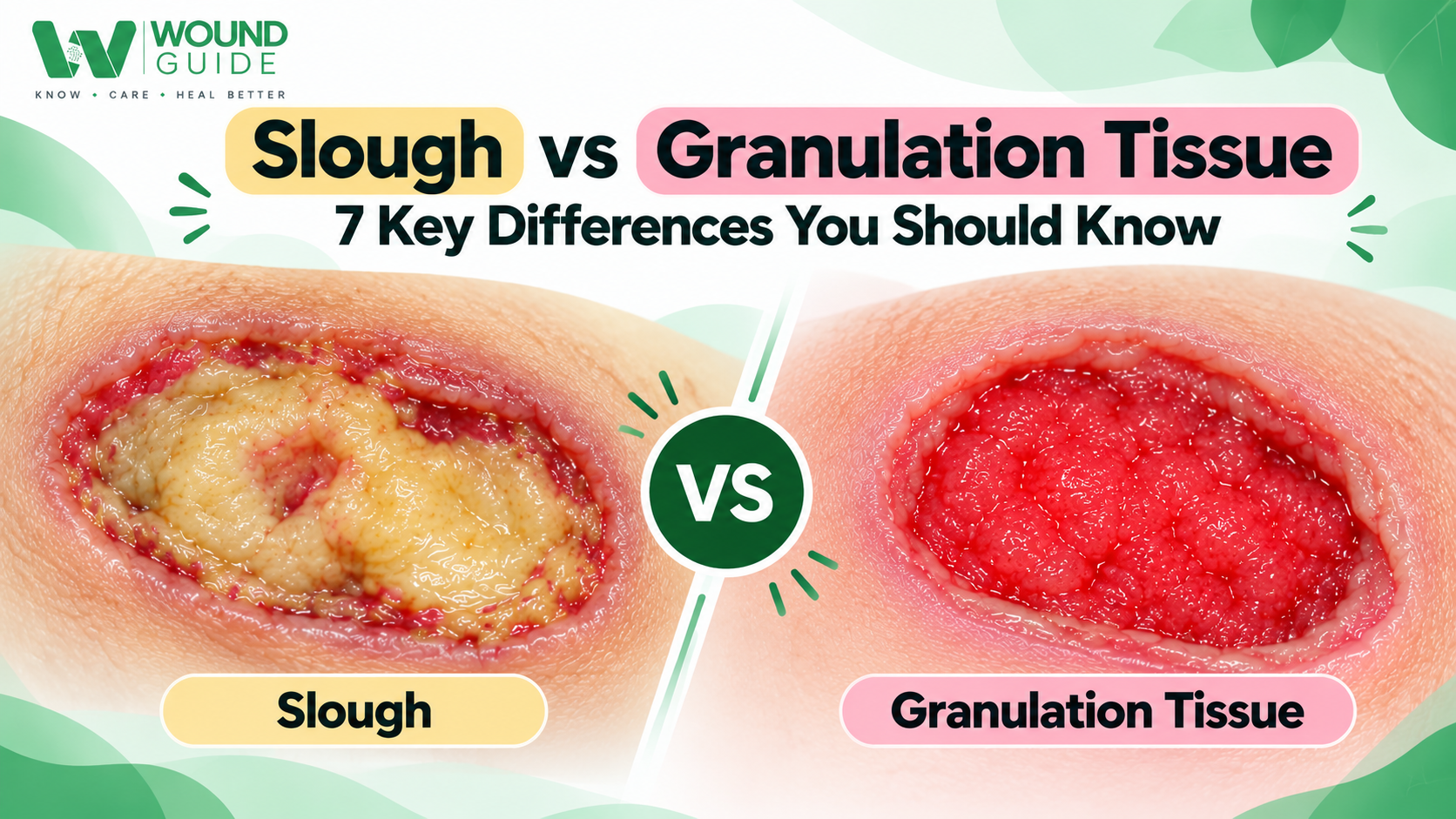
When you look at an open wound, you may notice yellow, white, pink, or red tissue inside the wound bed. But what does that tissue mean? Is the yellow material slough, or is the red tissue healthy granulation tissue. Understanding the difference between Slough vs Granulation Tissue can help patients and caregivers better understand what they are seeing during the wound-healing process. However, wound color alone cannot provide a complete diagnosis. Healthcare professionals also consider wound size, depth, drainage, odor, pain, surrounding skin, infection signs, and how the wound is changing over time.
“In this guide, we will explain 7 important Slough vs Granulation Tissue differences, what each may look like, why they develop, and when a wound should be professionally assessed.”
What Is Slough in a Wound?
“Understanding Slough vs Granulation Tissue starts with knowing what slough represents in the wound bed.”
It is commonly described as yellow, cream, tan, or white tissue. Depending on the wound, slough may appear soft, stringy, adherent, or moist.
Slough can contain a mixture of materials such as fibrin, degraded tissue components, wound fluid, inflammatory cells, and microorganisms. It is different from healthy granulation tissue and can interfere with the normal progression of wound healing. Slough may be seen in different types of chronic wounds, including:
- Diabetic foot ulcers
- Pressure injuries
- Venous leg ulcers
- Chronic non-healing wounds
- Other wounds with delayed healing
The presence of slough does not automatically mean that a wound is infected. Infection requires assessment of additional clinical signs.
What Is Granulation Tissue?
“To understand Slough vs Granulation Tissue, it is also important to know how healthy granulation tissue develops during wound repair.”
Granulation tissue is newly developing tissue that forms during the repair phase of wound healing.
It contains new connective tissue and small blood vessels and helps fill the wound bed. Healthy granulation tissue is commonly pink to red, moist, and granular or uneven in appearance.
As a wound progresses, granulation tissue can help create the foundation needed for epithelial cells to move across the wound surface.
You can learn more about its appearance and role in healing in our detailed guide on Granulation Tissue in Wounds.
Slough vs Granulation Tissue: 7 Key Differences
1. Color and Appearance
“When comparing Slough vs Granulation Tissue, color is often the first visible difference people notice.”
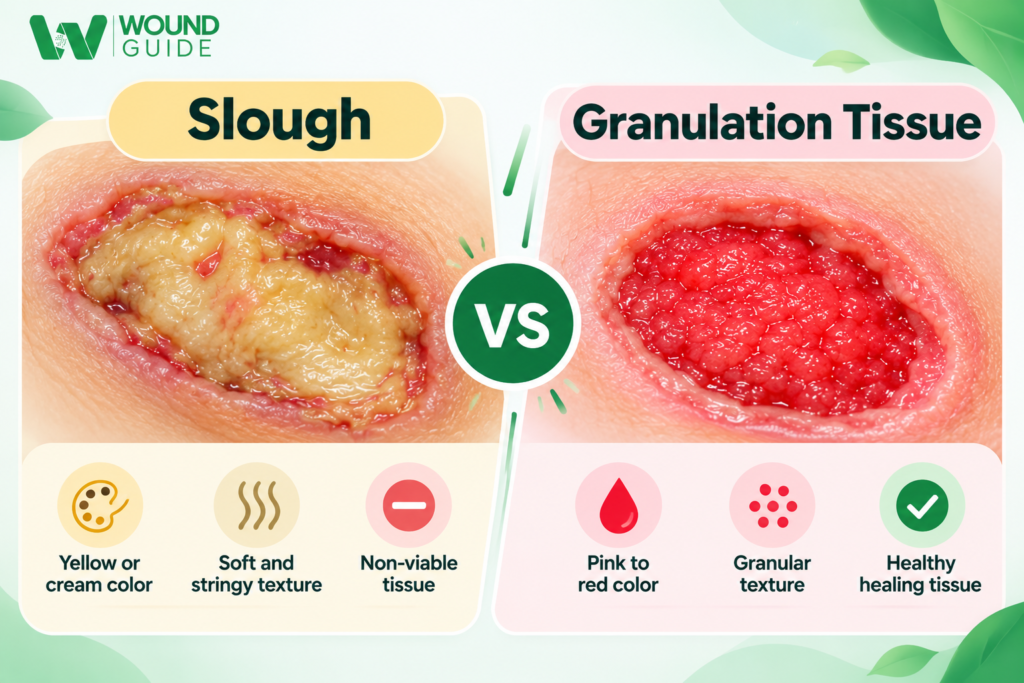
One of the easiest differences to notice is color, although color alone should never be used to diagnose a wound.
Slough
Slough commonly appears:
- Yellow
- Cream
- Tan
- White or yellowish-white
It may look stringy, sticky, soft, or attached to the wound bed.
Granulation Tissue
Healthy granulation tissue is commonly:
- Pink
- Bright red
- Deep pink to red
- Moist
- Uneven or granular
Healthy granulation tissue gets its red or pink appearance partly from its rich supply of small blood vessels.
Simple way to remember:
🟡 Yellow/cream tissue → may be slough
🔴 Pink/red granular tissue → may be granulation
But remember: appearance alone is not enough for diagnosis.
2. Tissue Function Is Different
Another major difference in Slough vs Granulation Tissue is what the tissue represents in the healing process.
Slough
Slough represents non-viable or devitalized wound-bed material and may interfere with the progression of healing.
When substantial slough is present, it can make it harder for healthcare professionals to accurately assess the wound bed.
Granulation Tissue
Granulation tissue is part of the body’s active repair process.
It helps:
- Fill the wound
- Provide a vascular tissue bed
- Support tissue repair
- Prepare the wound for epithelialization
Healthy granulation tissue is therefore generally considered a positive sign of wound repair.
3. Texture Can Be Different
“Texture can also help explain the difference between Slough vs Granulation Tissue, although it should not be used alone to diagnose a wound.”
Slough Texture
Slough can appear:
- Soft
- Stringy
- Sticky
- Fibrous
- Adherent
- Moist
Its exact appearance can vary depending on the wound and the amount of drainage.
Granulation Tissue Texture
Healthy granulation tissue can look:
- Fine
- Grainy
- Bumpy
- Uneven
- Moist
- Almost pebbled or granular
The irregular appearance is associated with the developing tissue and small blood vessels within the wound bed.
4. Bleeding Behavior May Differ
Healthy granulation tissue contains many small blood vessels.
Because of this, it can bleed easily when accidentally disturbed or traumatized.
For example, minor bleeding may occur when:
- A dressing sticks to the wound
- The wound is accidentally rubbed
- The tissue is disturbed during care
This does not automatically mean something is wrong.
However, persistent, heavy, or difficult-to-control bleeding is not normal and should receive medical attention.
Slough itself is not healthy vascular tissue and does not have the same appearance or behavior as healthy granulation tissue.
5. Their Role in Wound Healing Is Different
This is one of the most important differences.
Granulation Tissue Supports Healing
Granulation tissue develops as part of the wound repair process.
It provides a tissue foundation that allows the wound to gradually fill and supports the later process of epithelialization.
A fully granulated wound bed is generally characterized by granulation tissue filling the wound, with no obvious avascular tissue and no clinical signs of infection.
Slough Can Delay Progression
Slough is associated with devitalized material within the wound bed.
When slough is present, it may interfere with granulation and epithelialization. Wound-care professionals may therefore assess whether removal of non-viable tissue is appropriate.
Important: Never try to scrape, cut, or remove wound tissue yourself.
6. What They May Mean for Wound Progress
When comparing Slough vs Granulation Tissue, wound progress is another important consideration.
Granulation Tissue
The presence of healthy granulation tissue may indicate that the wound is progressing through an active repair phase.
You may see:
- The wound becoming shallower
- The wound gradually becoming smaller
- Healthy tissue filling the wound bed
- New epithelial tissue developing around the edges
These changes are generally more meaningful when considered over time rather than from a single visual inspection.
Slough
A wound with significant slough may have a larger amount of non-viable material covering the wound bed.
This can make it more difficult to determine the actual wound depth and underlying tissue condition. In some wounds, slough or eschar can even obscure the true extent of tissue loss.
7. The Management Approach Can Be Different
The final major difference involves wound management.
Granulation Tissue
Healthy granulation tissue should generally be protected from unnecessary trauma.
Appropriate wound care may involve:
- Gentle wound cleansing
- Protecting fragile tissue
- Selecting an appropriate dressing
- Managing wound drainage
- Preventing pressure and friction
- Monitoring for infection
Different wounds require different dressing approaches. Our guide to Wound Dressing Types explains how dressing selection can depend on drainage, wound depth, tissue condition, infection, and surrounding skin.
Slough
When slough is present, healthcare professionals may determine whether debridement or another method of wound-bed management is appropriate.
The method depends on:
- Wound type
- Amount of slough
- Wound depth
- Infection status
- Blood supply
- Patient health
- Location of the wound
Debridement should not be attempted at home.
Slough vs Granulation Tissue: Quick Comparison
“This Slough vs Granulation Tissue comparison provides a simple overview of the main differences discussed above.”
| Feature | Slough | Healthy Granulation Tissue |
| Typical color | Yellow, cream, tan or white | Pink to red |
| Role | Devitalized wound-bed material | Active tissue repair |
| Texture | Soft, stringy, sticky or adherent | Fine, granular, bumpy |
| Blood supply | Not healthy vascular tissue | Rich in small blood vessels |
| Bleeding | Does not behave like healthy vascular tissue | May bleed easily when disturbed |
| Healing role | May interfere with healing | Supports wound repair |
| Management | May require professional assessment and possible debridement | Usually protected during wound care |
This comparison is a general educational guide. Actual wound assessment requires more than identifying a tissue color or texture.
Is Yellow Tissue in a Wound Always Slough?
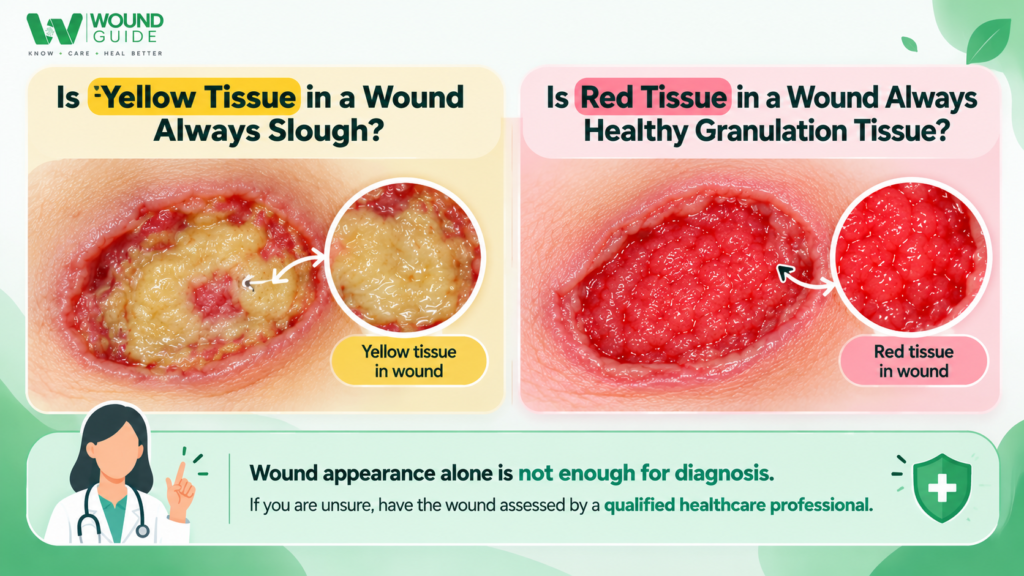
Yellow or white material in a wound does not automatically mean that it is slough.
Wound appearance can be affected by:
- Wound drainage
- Fibrin
- Dressing materials
- Moisture
- Infection
- Devitalized tissue
- Other wound-bed changes
This is why it is not recommended to diagnose a wound simply by looking at one color.
If you are unsure whether the yellow tissue is slough, it is better to have the wound assessed by an appropriately qualified healthcare professional.
Is Red Tissue in a Wound Always Healthy Granulation Tissue?
No.
Healthy granulation tissue is often pink or red, but redness can have other meanings.
For example, spreading redness around the wound, especially when associated with increasing pain, warmth, swelling, pus-like drainage, or fever, can be a warning sign of infection.
The location and appearance of the redness matter.
There is an important difference between:
Red/pink tissue inside the wound bed
and
Increasing redness spreading around the wound.
If you are unsure about the difference, professional assessment is recommended.
Can Slough Turn Into Granulation Tissue?
Slough does not simply “turn into” granulation tissue.
Instead, the wound-healing environment can change as non-viable tissue is appropriately managed and the wound progresses.
When the wound bed is suitable for healing, healthy granulation tissue may develop and progressively fill the wound. Appropriate wound management may include cleansing, treatment of infection when present, management of moisture, pressure relief, and professional debridement when indicated.
The goal is not simply to remove anything yellow. The underlying cause and overall wound condition need to be considered.
Does Slough Mean the wound is infected?
Not necessarily.
This is a very important point.
Slough and infection are not the same thing.
All open wounds can contain bacteria, but bacterial presence alone does not necessarily mean clinical infection. Infection is assessed using the overall clinical picture, including signs such as increasing pain, redness, swelling, warmth, purulent drainage, and other changes.
Seek professional assessment if the wound develops:
- Increasing pain
- Spreading redness
- Increasing warmth
- Swelling
- Pus-like drainage
- Foul odor
- Fever
- Rapid worsening
- Increasing wound size
What Causes Slough to Develop?
Slough can be associated with wounds that contain devitalized tissue or have delayed progression through healing.
Factors that can contribute to delayed wound healing include:
1. Infection
Infection can interfere with normal wound healing.
2. Poor Blood Circulation
Reduced blood supply can limit oxygen and nutrients reaching the wound.
3. Diabetes
Diabetes can contribute to neuropathy, circulation problems and delayed wound healing. People with diabetes should take foot wounds seriously. Wound Guide
For more information, read our complete guide to Diabetic Foot Ulcer Treatment.
4. Pressure
Constant pressure can prevent a wound from progressing normally.
5. Repeated Trauma
Repeated friction, scratching or pressure can damage developing tissue.
6. Poor Nutrition
Adequate nutrition is important for tissue repair and overall wound healing.
What If a Wound Has Both Slough and Granulation Tissue?
A wound does not always contain only one tissue type.
It is possible for slough and granulation tissue to appear in different areas of the same wound.
For example, part of a wound bed may contain healthy red granulation tissue while another area has yellow slough.
This is one reason professional wound assessment is important.
Healthcare professionals may evaluate:
- Percentage of granulation tissue
- Amount of slough
- Presence of necrotic tissue
- Wound depth
- Drainage
- Wound edges
- Surrounding skin
- Infection signs
- Blood circulation
- Pain
- Overall wound progression
The wound bed can change over time, so assessment may need to be repeated.
When Should You See a Wound Care Professional?
Professional assessment is especially important when a wound:
- Is getting larger
- Is becoming deeper
- Has increasing pain
- Develops spreading redness
- Becomes swollen or warm
- Produces pus-like drainage
- Develops a strong odor
- Bleeds repeatedly
- Contains black or dead-looking tissue
- Stops improving
- Has significant slough
- Occurs on the foot of someone with diabetes
A wound that does not improve despite appropriate care may require further investigation to identify the underlying cause. WoundGuide’s Non-Healing Ulcer Differential Diagnosis guide explains why persistent ulcers may need assessment for circulation problems, diabetes, pressure, infection and other causes.
Frequently Asked Questions
Slough is commonly described as yellow, cream, tan, or white/yellowish material. Its exact appearance can vary depending on the wound.
No. Slough does not automatically mean infection. Infection is determined by the overall clinical signs and wound assessment.
Yes. Healthy granulation tissue contains many small blood vessels and may bleed when disturbed. Persistent or heavy bleeding needs medical assessment.
No. Do not cut, scrape, or pull wound tissue yourself. A healthcare professional should determine whether debridement is necessary and which method is appropriate.
The simplest distinction is that healthy granulation tissue is newly developing vascular tissue involved in repair, while slough is non-viable/devitalized wound-bed material. However, visual appearance alone cannot reliably diagnose every wound.
Final Thoughts
“Knowing the basic differences between Slough vs Granulation Tissue can help patients better understand changes in a wound.”
In simple terms, healthy granulation tissue is usually pink to red, moist, and granular, while slough is commonly yellow, cream, tan, or white and represents devitalized wound-bed material. But a wound should never be judged by color alone.
Wound size, depth, drainage, odor, pain, surrounding skin, infection signs, circulation, and healing progress all matter.
Most importantly, never cut or scrape wound tissue yourself. If a wound is getting larger, increasingly painful, producing unusual drainage, developing a foul odor, repeatedly bleeding, or failing to heal, professional assessment is important.
🩹 Need Help With a Wound?
Don’t ignore changes in your wound.
WoundGuide provides wound-care information and guidance for people dealing with chronic, diabetic, pressure-related, infected, and difficult-to-heal wounds.
👉 Learn more about wound care and get appropriate guidance from WoundGuide.
Leave a Reply