
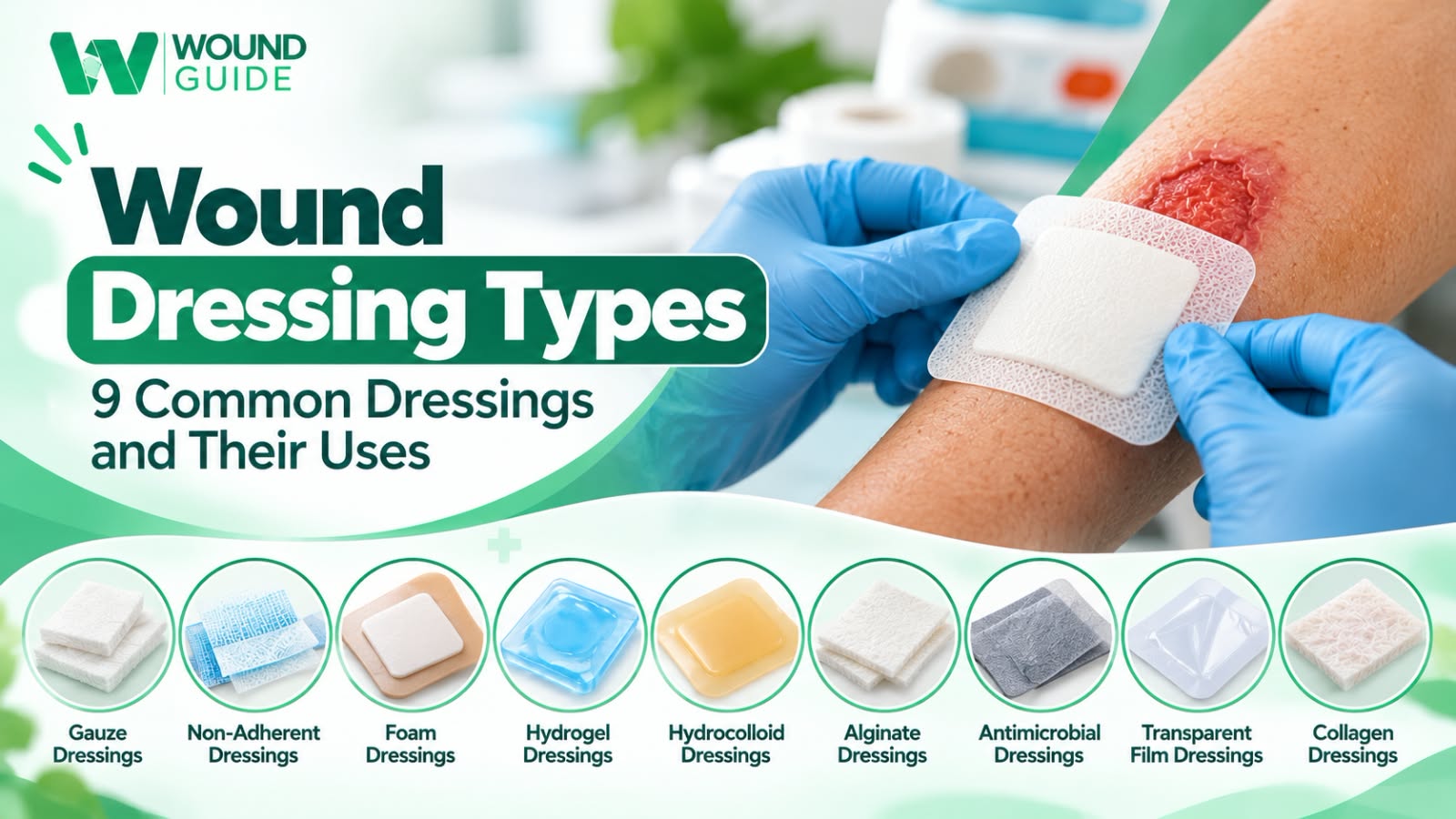
Wound Dressing Types can make a major difference in how a wound is protected, how wound fluid is managed, and how comfortable the healing process is. But with so many dressing products available, it can be confusing to know which one is appropriate for a particular wound. A small superficial wound may need a simple protective dressing, while a chronic ulcer, diabetic foot wound, infected wound, or heavily draining wound may require a more specialized approach. The important point is that there is no single best dressing for every wound. Dressing selection depends on factors such as wound depth, amount of drainage, tissue condition, infection, surrounding skin, and the underlying cause of the wound.
What Is a Wound Dressing?
A wound dressing is a material placed over a wound to help protect it from external contamination and trauma while supporting appropriate wound management.
Depending on the product, a dressing may help:
- Manage wound drainage
- Protect newly forming tissue
- Maintain an appropriate moisture balance
- Reduce friction
- Protect the surrounding skin
- Control odor in selected situations
- Deliver antimicrobial substances when specifically indicated
- Make wound care more comfortable
Modern wound care generally aims to maintain an appropriate wound environment rather than simply allowing an open wound to dry out. However, excessive moisture and drainage can also damage surrounding skin, so the dressing needs to match the wound’s condition.
How Are Wound Dressing Types Selected?
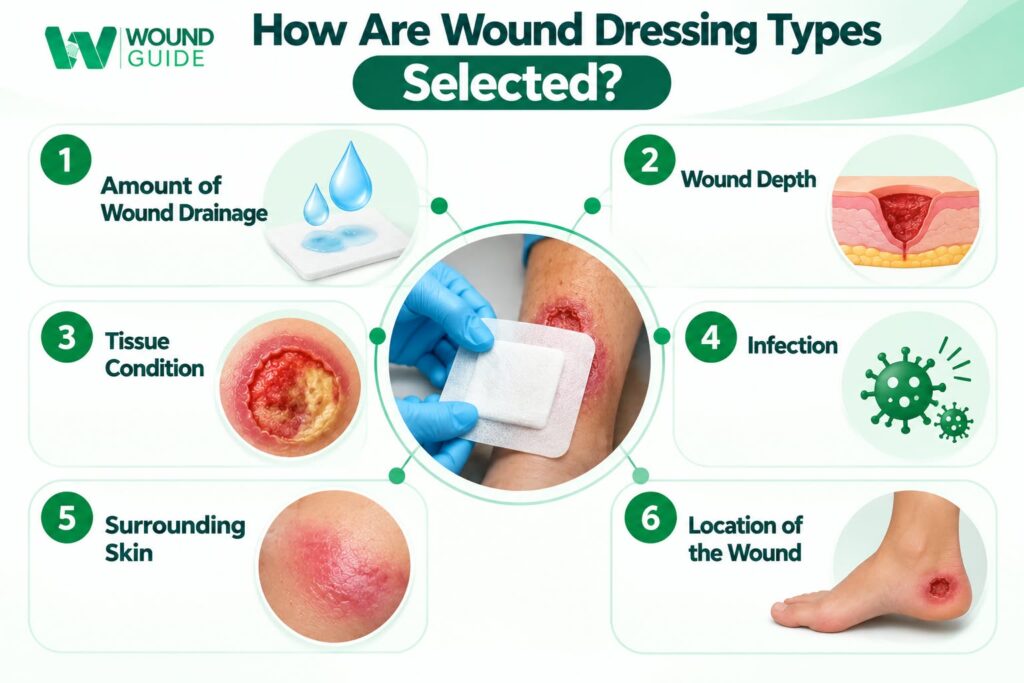
Choosing between different Wound Dressing Types is not simply about picking the most advanced or expensive product.
Healthcare professionals usually consider:
1. Amount of Wound Drainage
A wound producing a lot of fluid may require a dressing with greater absorption.
A relatively dry wound may need a dressing designed to add or preserve moisture instead.
2. Wound Depth
Superficial wounds and deeper wounds may require different products and, in some cases, different levels of medical care.
3. Tissue Condition
The wound may contain healthy granulation tissue, slough, necrotic tissue, or other changes that affect dressing selection.
4. Infection
A clinically infected wound may need additional treatment. An antimicrobial dressing may sometimes be considered, but simply placing an antimicrobial product over an untreated infection is not a substitute for appropriate medical assessment.
5. Surrounding Skin
Excess moisture can cause maceration and irritation around a wound. Dressing selection should therefore consider both the wound and the surrounding skin.
6. Location of the Wound
A dressing for the heel, foot, ankle, or another high-friction area may need different protective properties.
For example, pressure management is particularly important for pressure injuries, while diabetic foot wounds may require pressure offloading alongside wound care.
9 Common Wound Dressing Types and Their Uses
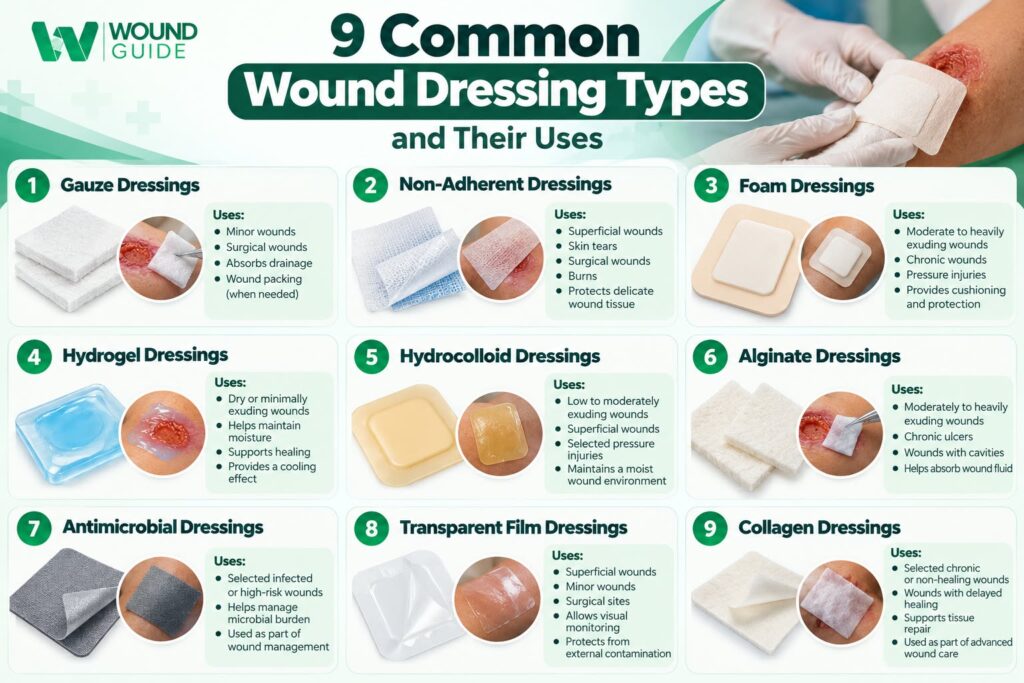
1. Gauze Dressings
Gauze is one of the most familiar Wound Dressing Types and has been used for wound protection and packing for many years.
It can be used as a primary or secondary dressing depending on the wound and product.
Common uses
Gauze may be used for:
- Minor wounds
- Surgical wounds
- Wound packing when specifically indicated
- Absorbing wound drainage
- Covering another primary dressing
Things to know
Some dry gauze products can stick to the wound bed. Removing an adherent dressing may cause discomfort or disturb fragile tissue.
For this reason, the type of gauze and how it is used matter.
2. Non-Adherent Dressings
Non-adherent dressings are designed to minimize sticking to the wound surface.
They can be useful when protecting fragile tissue is important.
Common uses
They may be considered for:
- Superficial wounds
- Surgical wounds
- Skin tears
- Burns
- Wounds with delicate granulation tissue
A non-adherent layer may also be used underneath a more absorbent secondary dressing.
This type of dressing can make dressing changes more comfortable when appropriately selected.
3. Foam Dressings
Foam is another widely used category of wound dressing.
Foam dressings are generally designed to absorb wound exudate while providing cushioning and protection.
Common uses
They may be useful for:
- Moderate to heavily exuding wounds
- Chronic wounds
- Pressure injuries
- Some leg ulcers
- Wounds requiring additional protection
Foam dressings can be particularly useful when managing wound fluid while protecting the wound from external friction.
However, the specific absorption capacity varies between products, so the dressing should be selected according to the amount of drainage.
4. Hydrogel Dressings
Hydrogel dressings contain a high proportion of water and are generally used when hydration of the wound environment is needed.
Common uses
Hydrogels may be considered for:
- Dry or minimally exuding wounds
- Some wounds with devitalized tissue
- Selected ulcers
- Wounds where a cooling effect may improve comfort
They generally have limited absorption capacity, so they are not usually appropriate for wounds producing heavy drainage. NCBI
A secondary dressing may also be required.
5. Hydrocolloid Dressings
Hydrocolloids contain materials that interact with wound fluid and form a gel-like environment.
They are designed to protect the wound while supporting an appropriate moist environment.
Common uses
Hydrocolloid dressings may be used for:
- Some superficial wounds
- Low-to-moderately exuding wounds
- Selected pressure injuries
- Some minor wounds
They are not suitable for every wound, particularly wounds with heavy drainage or certain clinically infected wounds.
The wound should therefore be assessed before choosing this type of dressing.
6. Alginate Dressings
Alginate dressings are made from materials derived from seaweed and are designed to interact with wound fluid.
They can be highly absorbent compared with some other dressing categories.
Common uses
Alginate dressings may be considered for:
- Moderately to heavily exuding wounds
- Some chronic ulcers
- Wounds with cavities or areas requiring packing, when clinically appropriate
- Selected wounds where bleeding control properties are relevant
They generally require an appropriate secondary dressing.
Because dressing products differ in their characteristics, healthcare professionals should determine whether an alginate is appropriate for a specific wound.
7. Antimicrobial Dressings
Antimicrobial dressings contain substances intended to reduce or manage microbial burden in selected wound situations.
Examples can include dressings containing silver or other antimicrobial agents.
Common uses
Depending on the product and clinical situation, they may be considered when:
- There is concern about increased bioburden
- Infection risk is being managed
- A wound has specific clinical characteristics requiring antimicrobial management
However, antimicrobial does not automatically mean better.
Not every wound needs an antimicrobial dressing, and a clinically infected wound may require medical treatment beyond a dressing.
The decision should be based on professional wound assessment.
8. Transparent Film Dressings
Transparent film dressings are thin, flexible coverings that allow visual monitoring of the wound or underlying site.
They are generally not designed to absorb significant amounts of wound fluid.
Common uses
They may be useful for:
- Superficial wounds
- Minor wounds
- Selected surgical sites
- IV access sites
- Protecting another dressing
Because films have little or no absorbency, they are generally unsuitable for wounds producing moderate or heavy drainage. NCBI
9. Collagen Dressings
Collagen-based dressings are another category used in selected chronic or difficult-to-heal wounds.
They are designed to interact with the wound environment and may be considered as part of a broader wound management plan.
Common uses
Depending on the wound and product, collagen dressings may be considered for:
- Selected chronic wounds
- Wounds with delayed healing
- Some diabetic ulcers
- Wounds requiring advanced dressing approaches
Collagen products are not appropriate for every wound, and their use should be based on professional assessment.
Wound Dressing Types: Quick Comparison
| Dressing Type | Common Purpose | Drainage Level |
|---|---|---|
| Gauze | Protection, coverage, packing when appropriate | Low–high depending on product |
| Non-adherent | Protect fragile wound tissue | Low–moderate |
| Foam | Absorption and protection | Moderate–high |
| Hydrogel | Add moisture to dry wounds | Low |
| Hydrocolloid | Moist wound environment | Low–moderate |
| Alginate | Absorb wound fluid | Moderate–high |
| Antimicrobial | Selected microbial-management situations | Depends on product |
| Transparent film | Protection and visibility | Minimal |
| Collagen | Selected chronic/delayed-healing wounds | Depends on product |
Remember: this table is a general guide, not a substitute for wound assessment. The same wound may require different dressings as it changes during healing.
How to Choose the Right Wound Dressing
The right choice depends on the individual wound, not just the wound’s name.
For example, two people may both have diabetic foot ulcers but have very different amounts of drainage, tissue condition, depth, infection status, and circulation.
A healthcare professional may therefore change the dressing as the wound progresses.
Consider these questions:
Is the wound dry or producing fluid?
Dry wounds and heavily exuding wounds generally require different approaches.
Is the wound superficial or deep?
A deeper wound may require more comprehensive assessment and treatment.
Is there infection?
Increasing redness, swelling, pus, foul odor, fever, or rapidly worsening symptoms require medical attention.
Is the surrounding skin becoming damaged?
Excessive moisture can irritate the skin surrounding a wound.
Is pressure contributing to the wound?
For pressure injuries, changing the dressing alone does not remove the underlying cause. Pressure relief and repositioning may be essential. Wound Guide
Is diabetes involved?
A diabetic foot wound should receive appropriate professional assessment because neuropathy, circulation problems, infection, and pressure can all affect healing.
For more information, see WoundGuide’s guide to diabetic foot ulcer treatment and heel pressure ulcers.
Common Wound Dressing Mistakes to Avoid
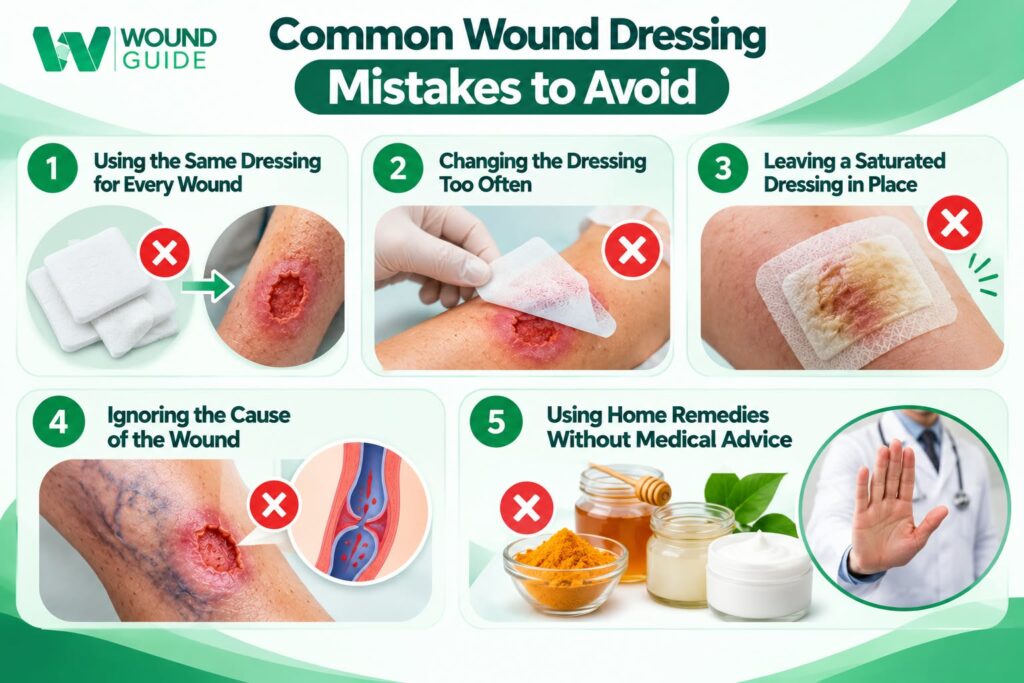
Choosing the wrong dressing can make wound management more difficult.
1. Using the Same Dressing for Every Wound
Different wounds have different needs. A dressing that works for a dry wound may not be appropriate for a heavily draining ulcer.
2. Changing the Dressing Too Often
Changing a dressing unnecessarily can disturb fragile tissue and increase discomfort.
The appropriate frequency depends on the dressing, wound condition, drainage, and clinical instructions.
3. Leaving a Saturated Dressing in Place
If a dressing can no longer manage wound fluid or leakage is occurring, it may need reassessment or replacement.
4. Ignoring the Cause of the Wound
A dressing covers the wound, but it does not necessarily correct the underlying problem.
For example, venous ulcers may require management of venous disease, while pressure injuries require pressure relief.
You can learn more about venous wounds in WoundGuide’s article on venous ulcers.
5. Using Home Remedies Without Medical Advice
Products such as household substances, powders, or unapproved creams should not be applied to an open wound without professional guidance.
When Should You See a Wound Care Professional?
Not every wound requires specialist care, but professional assessment is particularly important when a wound:
- Is not healing as expected
- Is becoming larger or deeper
- Produces increasing drainage
- Develops pus
- Has a foul odor
- Becomes increasingly red or swollen
- Becomes more painful
- Develops black or severely discolored tissue
- Occurs on the foot of someone with diabetes
- Develops in a person with poor circulation
- Is associated with fever or feeling unwell
If you have a chronic wound, choosing between Wound Dressing Types without first identifying the underlying cause may delay appropriate treatment.
WoundGuide provides information and wound-care support for conditions including diabetic foot ulcers, pressure ulcers, venous ulcers, arterial ulcers, and infectious wounds. Wound Guide
Frequently Asked Questions
There is no single best dressing for every wound. The appropriate choice depends on wound depth, drainage, tissue condition, infection, location, and the patient’s overall health.
Absorbent dressings such as certain foam or alginate products may be considered for heavily exuding wounds. The specific product should be selected according to the wound assessment.
Hydrogels can be useful for selected dry or minimally exuding wounds because they provide moisture. They generally have limited absorption capacity and are not designed for heavily draining wounds. NCBI
No. Antimicrobial dressings are not automatically required for every wound. Their use should be based on the clinical situation and professional assessment.
There is no universal schedule. The frequency depends on the dressing product, wound drainage, wound condition, and instructions from the healthcare professional.
Final Thoughts
Understanding Wound Dressing Types can help patients and caregivers make better-informed decisions about wound care.
Gauze, non-adherent dressings, foams, hydrogels, hydrocolloids, alginates, antimicrobial dressings, transparent films, and collagen dressings all have different characteristics and potential uses.
The most important thing to remember is that the right dressing depends on the wound.
A chronic wound, diabetic foot ulcer, pressure injury, infected wound, or wound with heavy drainage should not be managed by choosing a dressing based only on appearance or price. Proper wound assessment can help identify the cause, determine the wound’s needs, and decide when specialist treatment is necessary.
🩹 Need Help With a Wound?
Don’t let a wound become a bigger problem.
If you or someone you care for has a non-healing, diabetic, pressure-related, infected, or chronic wound, getting the right assessment can help you understand what care may be needed.
👉 Talk to WoundGuide for professional wound-care guidance
Your wound deserves the right assessment and care.
Leave a Reply